A car refrigerator may look like a compact version of a household refrigerator, but its working environment is very different. It has to operate from a vehicle's electrical system while dealing with vibration, changing outdoor temperatures, limited installation space, and long periods of continuous operation.
So, how does a car refrigerator actually produce cold air?
The answer depends largely on the cooling technology used inside the unit. Most portable and vehicle-mounted refrigerators fall into two categories: thermoelectric (Peltier) refrigerators and compressor refrigerators. Although both are designed to reduce temperature, they use completely different physical processes.
Understanding this difference is useful when choosing a refrigerator for a truck, RV, SUV, boat, or other mobile application.
What Is A Car Refrigerator?
A car refrigerator is a compact refrigeration appliance designed to operate in a mobile environment. Instead of relying exclusively on a household AC power supply, many models are designed for vehicle power systems such as 12V or 24V DC.
Depending on the design, a vehicle refrigerator can be used to cool beverages, preserve fresh food, freeze selected items, or maintain a relatively stable temperature during long-distance travel.
The two most common cooling technologies are:
- Thermoelectric cooling based on the Peltier effect
- Compressor-based refrigeration using a refrigerant cycle
The difference between these technologies determines cooling performance, temperature range, energy consumption, size, noise level, and ultimately the best application for the refrigerator.
How Does A Thermoelectric Car Refrigerator Work?

A thermoelectric refrigerator uses semiconductor materials rather than a conventional compressor and refrigerant circuit.
Its core component is a Peltier module, which contains semiconductor elements arranged between two ceramic plates. When direct current passes through the module, heat is transferred from one side to the other.
One side becomes cold while the opposite side becomes hot.
The cold side is connected to the refrigerator compartment, where it absorbs heat from the contents. The hot side transfers that heat to a heat sink and fan, which release it into the surrounding environment.
This creates a simple solid-state cooling system without the moving mechanical components found in compressor refrigeration.
The Peltier Effect in Simple Terms
The Peltier effect occurs when an electric current passes through the junction of different semiconductor materials.
As charge carriers move through the semiconductor junctions, heat is absorbed on one side of the module and released on the other. Reversing the direction of the current reverses the direction of heat transfer.
This is why some thermoelectric refrigerators can provide both cooling and heating by changing the electrical polarity.
Advantages of Thermoelectric Cooling
The relatively simple construction of a thermoelectric system provides several advantages:
- Compact and lightweight design
- No compressor or refrigerant circuit
- Low mechanical vibration
- Quiet operation
- Simple construction
- Cooling and heating capability in many designs
- Generally lower initial equipment cost
These characteristics make thermoelectric refrigerators attractive for short trips, beverage cooling, personal use, and applications where portability is more important than deep freezing.
Limitations of Thermoelectric Refrigerators
The biggest limitation is cooling capacity.
A thermoelectric refrigerator does not actively create a very low temperature in the same way a compressor refrigeration system does. Its performance is strongly influenced by the temperature difference between the refrigerator and its surrounding environment.
For example, if the outside temperature becomes very high, the thermoelectric system has to remove heat against a larger temperature difference. As a result, the actual internal temperature may rise.
For this reason, thermoelectric cooling is generally better suited to cooling and temperature maintenance than applications requiring reliable deep freezing.
How Does A Compressor Car Refrigerator Work?

A compressor refrigerator uses a refrigeration cycle similar to the technology found in conventional refrigerators and freezers.
Instead of using a semiconductor module to transfer heat directly, it uses a refrigerant that continuously circulates through a closed system.
The basic refrigeration cycle consists of four key stages:
Compression
Condensation
Expansion
Evaporation
Each stage has a specific role in moving heat from inside the refrigerator to the outside environment.
1. Compression
The compressor draws low-pressure refrigerant vapor from the evaporator and compresses it.
As the refrigerant is compressed, its pressure and temperature increase. The resulting high-pressure, high-temperature vapor then moves toward the condenser.
The compressor is effectively the driving force of the refrigeration cycle.
2. Condensation
The hot refrigerant enters the condenser, where heat is transferred to the surrounding air.
As the refrigerant loses heat, it changes from a high-pressure vapor into a high-pressure liquid.
This stage is important because the heat originally removed from the refrigerator compartment is ultimately released into the external environment.
3. Expansion
The high-pressure liquid refrigerant then passes through an expansion device.
Its pressure drops rapidly, causing the refrigerant temperature to fall. The refrigerant is now prepared to absorb heat again as it enters the evaporator.
4. Evaporation
The cold, low-pressure refrigerant enters the evaporator inside or near the refrigerated compartment.
As it evaporates, it absorbs heat from the refrigerator's interior. The refrigerant changes back into a vapor and returns to the compressor, beginning the cycle again.
This continuous process allows the refrigerator to remove heat rather than simply blowing cold air into the compartment.
Why Can Compressor Refrigerators Reach Lower Temperatures?
The main advantage of compressor refrigeration is its ability to create and maintain a much larger temperature difference between the refrigerator interior and the surrounding environment.
Depending on the specific design, a compressor car refrigerator can typically reach temperatures around -18°C, making it suitable for applications that require freezing as well as ordinary refrigeration.
This makes compressor technology particularly useful for:
- Long-distance truck drivers
- RV travelers
- Outdoor activities
- Frozen food transportation over short distances
- Extended road trips
- Mobile food storage
- Commercial vehicle applications
A compressor refrigerator is generally more suitable when users need dependable low-temperature performance rather than simple cooling.
Thermoelectric Vs. Compressor Car Refrigerators

The two technologies are not necessarily competitors in every application. Each solves a different problem.
| Feature | Thermoelectric Refrigerator | Compressor Refrigerator |
|---|---|---|
| Cooling principle | Peltier effect | Refrigerant cycle |
| Compressor | No | Yes |
| Moving mechanical parts | Very few | Yes |
| Typical cooling performance | Moderate | High |
| Deep freezing | Generally limited | Suitable |
| Temperature stability | More affected by ambient temperature | Better |
| Vibration | Very low | Some mechanical vibration |
| Cooling & heating | Possible | Primarily cooling |
| Weight | Usually lighter | Usually heavier |
| Initial cost | Generally lower | Generally higher |
| Best suited for | Short trips and basic cooling | Long-term cooling and freezing |
The right choice therefore depends less on which technology is "better" and more on what the refrigerator is expected to do.
What Factors Affect Car Refrigerator Cooling Performance?
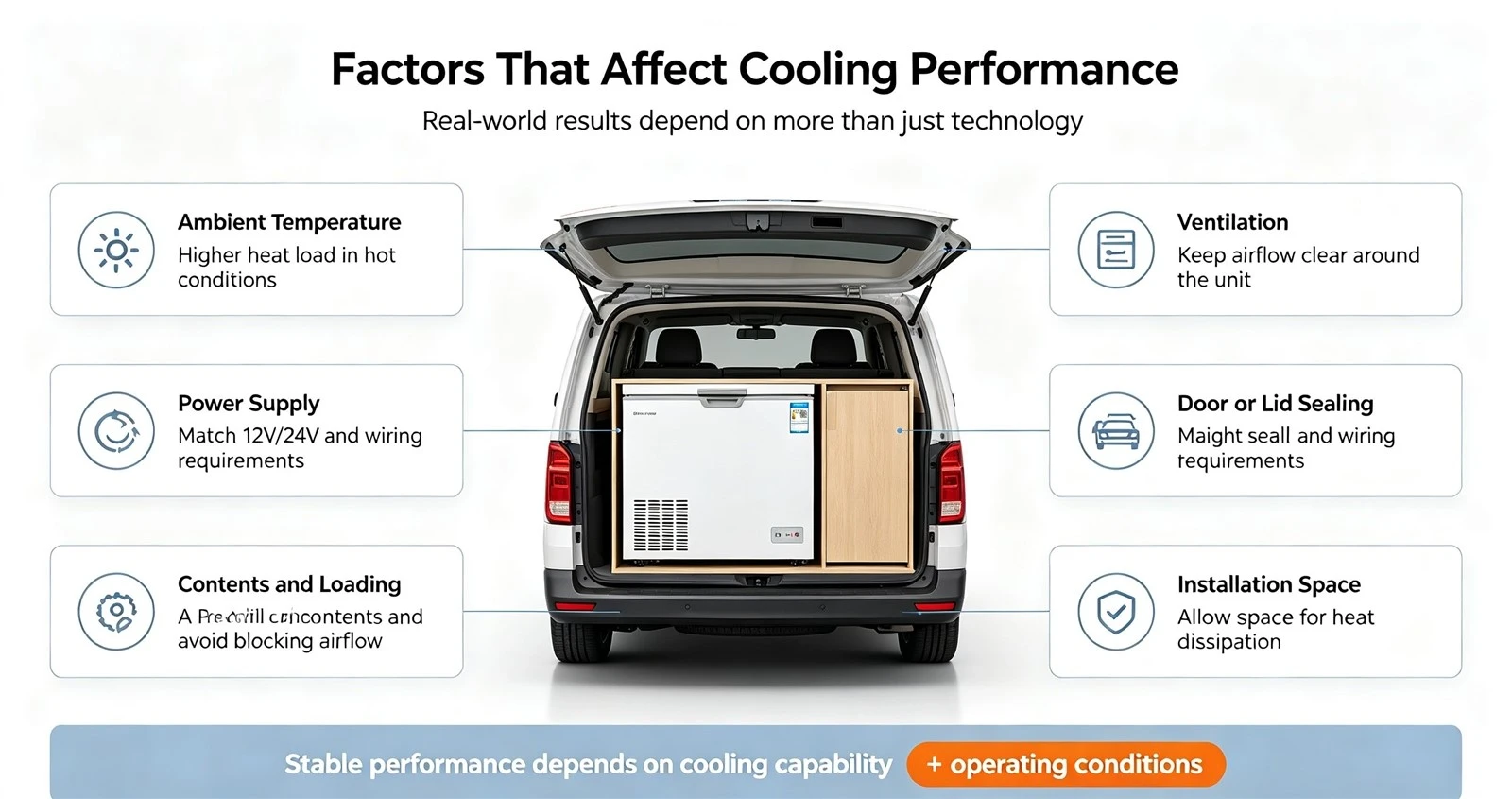
The refrigeration technology is only one part of the equation. Real-world performance also depends on several external factors.
Ambient Temperature
A refrigerator operating in a hot vehicle environment has to remove more heat. High ambient temperatures can therefore increase the workload of the cooling system.
01
Ventilation
A refrigerator needs to release heat efficiently. If the condenser or ventilation openings are blocked, heat can accumulate around the unit and reduce cooling efficiency.
This is especially important when installing a refrigerator inside a truck cabin, RV cabinet, or other enclosed space.
02
Power Supply
Vehicle refrigerators depend on a stable electrical supply. Insufficient voltage, poor wiring, loose connections, or an unsuitable power source can affect operation.
For this reason, users should select a refrigerator that matches the vehicle's electrical system and follow the manufacturer's installation requirements.
03
Door Or Lid Sealing
Warm air can enter through gaps around a poorly sealed door or lid. A damaged or dirty sealing strip can therefore increase cooling demand and make it harder for the refrigerator to maintain its target temperature.
04
Contents And Loading
Putting a large quantity of warm food into a refrigerator at once requires additional cooling capacity and time.
For better performance, pre-chilled items should be used whenever possible, and the internal airflow should not be unnecessarily restricted.
05
Which Car Refrigerator Technology Is Better?
There is no universal answer.
A thermoelectric refrigerator can be a practical option when portability, simple construction, quiet operation, and basic cooling are the priorities.
A compressor car refrigerator is generally the better choice when users require lower temperatures, faster cooling, more stable temperature control, or freezing capability.
For truck drivers and RV users who spend extended periods on the road, compressor technology is often more suitable because refrigeration performance is less dependent on a small temperature difference between the unit and the surrounding environment.
The decision should ultimately be based on the intended temperature range, operating duration, available power, installation space, and expected ambient conditions.
Choosing A Car Refrigerator For Vehicle Use
Before purchasing a car refrigerator, it is worth looking beyond the advertised temperature alone.
Consider the following:
- Power compatibility: Check whether the refrigerator is designed for the vehicle's 12V, 24V, or other available power supply.
- Cooling range: Decide whether you only need chilled beverages and fresh food or whether you also need freezing capability.
- Installation environment: Make sure there is sufficient space around ventilation areas for effective heat dissipation.
- Operating time: A refrigerator used occasionally for weekend trips may have very different requirements from one operating continuously in a commercial truck.
- Temperature control: For long-distance travel, stable temperature management can be more important than simply achieving the lowest possible temperature.
DONJELION's Approach To Vehicle Refrigeration
For mobile refrigeration, reliability cannot be separated from the environment in which the equipment operates.
DONJELION focuses on vehicle-oriented climate and refrigeration solutions, with product development centered on the practical requirements of drivers and mobile applications. A vehicle refrigerator needs to work within the limitations of automotive power systems while maintaining useful cooling performance during changing road and weather conditions.
For users comparing different refrigeration technologies, understanding the underlying cooling principle is the first step. Once the difference between thermoelectric and compressor systems is clear, it becomes much easier to select a refrigerator according to actual operating requirements rather than simply comparing price or appearance.
Frequently Asked Questions
1. Can a car refrigerator freeze food?
Yes, a compressor-based car refrigerator can typically reach freezing temperatures, with some models capable of reaching approximately -18°C. Thermoelectric models generally have more limited low-temperature performance.
2. Does a car refrigerator use a lot of electricity?
Power consumption varies according to the refrigeration technology, capacity, ambient temperature, insulation, temperature setting, and operating conditions. Compressor refrigerators may draw more power when actively cooling, but they cycle on and off rather than running continuously at full power.
3. Can a car refrigerator run on a car battery?
Many vehicle refrigerators are designed for 12V or 24V electrical systems. However, the refrigerator should be matched to the vehicle's power supply, and low-voltage protection is useful for preventing excessive battery discharge.
4. Why does my car refrigerator cool slowly?
Slow cooling can be caused by high ambient temperature, poor ventilation, insufficient power supply, frequent opening of the lid or door, warm contents, or a refrigeration system that is not operating correctly.
5. Is a compressor refrigerator better than a thermoelectric refrigerator?
For deep cooling, freezing, and long-duration refrigeration, a compressor refrigerator is generally the more capable option. Thermoelectric refrigeration can be preferable when low weight, simplicity, quiet operation, and basic cooling are the main priorities.
Final Thoughts
The basic principle behind a car refrigerator is straightforward: heat must be moved from inside the refrigerated compartment to the outside environment.
Thermoelectric refrigerators accomplish this through the Peltier effect, while compressor refrigerators use a closed-loop refrigerant cycle involving compression, condensation, expansion, and evaporation.
Understanding this difference helps users make a more informed decision. If the requirement is simple cooling in a compact and lightweight package, thermoelectric technology may be sufficient. If the application involves long trips, temperature stability, or freezing, compressor refrigeration offers a more capable solution.
For anyone purchasing a refrigerator for a truck, RV, or other vehicle, the best system is ultimately the one that matches the real operating conditions-not simply the one with the lowest price or the most impressive specification.