

When choosing a truck parking air conditioner, many drivers focus on cooling capacity. A unit with a higher cooling capacity may seem like the best choice, especially during hot summer nights.
However, cooling capacity is only part of the picture. Airflow is another important factor that affects cooling performance, temperature distribution, and sleeping comfort inside a truck cab.
An air conditioner may produce enough cooling power, but if cool air cannot reach the sleeper berth and other parts of the cab, some areas may remain uncomfortable.
For truck drivers, fleet operators, and buyers comparing truck parking air conditioners, understanding airflow can help them choose a system that delivers more consistent comfort during overnight stops.
Cooling Capacity And Airflow: What Is The Difference?
Cooling capacity and airflow work together, but they serve different purposes.
Cooling capacity measures how much heat an air conditioner can remove over time.
Airflow measures the volume of air that passes through the system, usually expressed in cubic meters per hour (m³/h) or cubic feet per minute (CFM).
In simple terms, cooling capacity determines how much heat the system can remove, while airflow helps distribute that cooling throughout the cab.
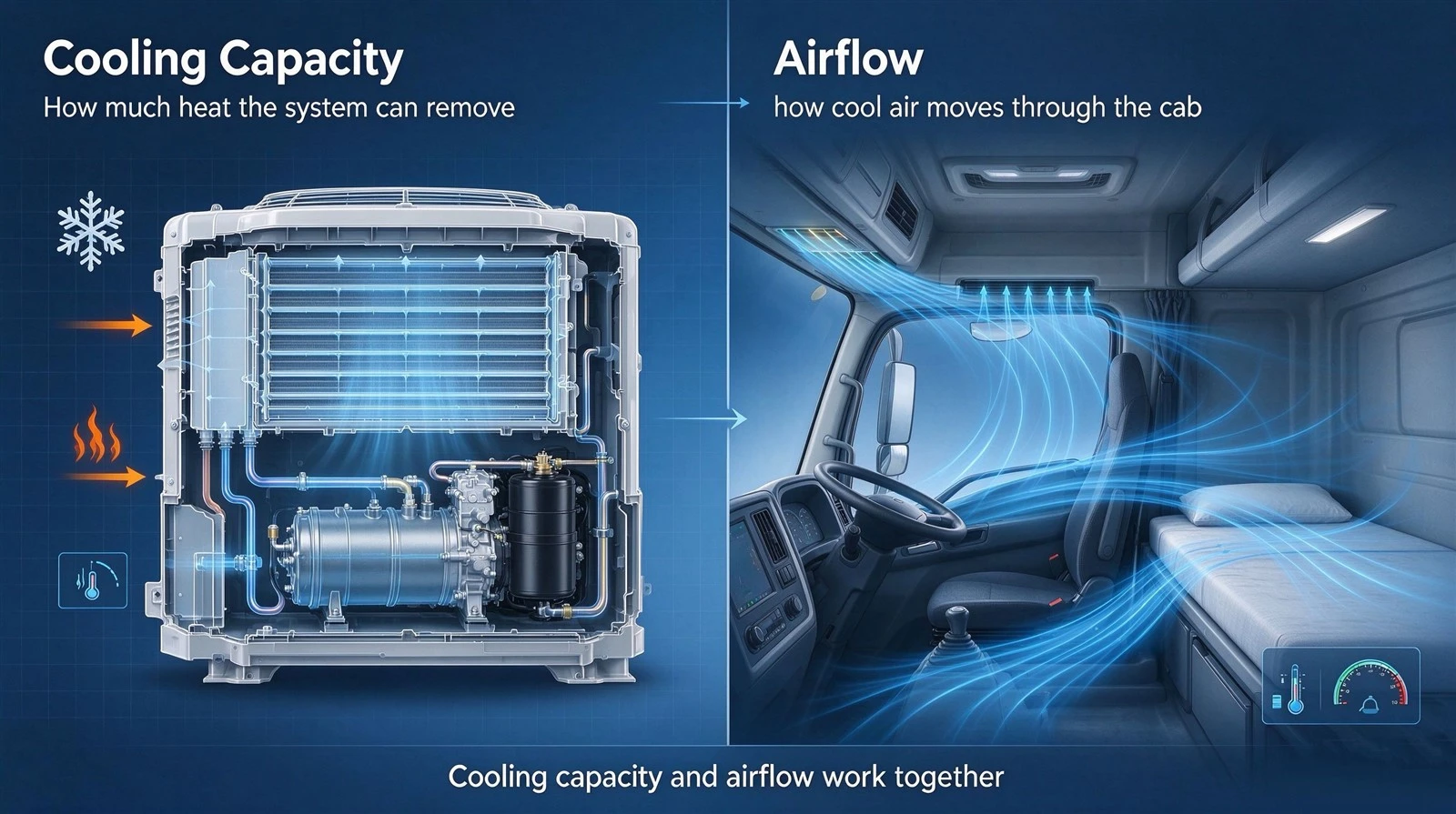
Imagine a truck parking air conditioner with sufficient cooling capacity but limited airflow. The area near the air outlet may become cold quickly, while the rear sleeper berth remains warm. The compressor may continue working, but the driver may still feel uncomfortable.
A well-matched system needs both adequate cooling capacity and effective air distribution.
Higher airflow does not automatically mean greater cooling capacity or better energy efficiency. Actual performance depends on the evaporator, fan, air ducts, compressor, refrigerant circuit, and the overall system design.
Why Airflow Matters In A Truck Cab
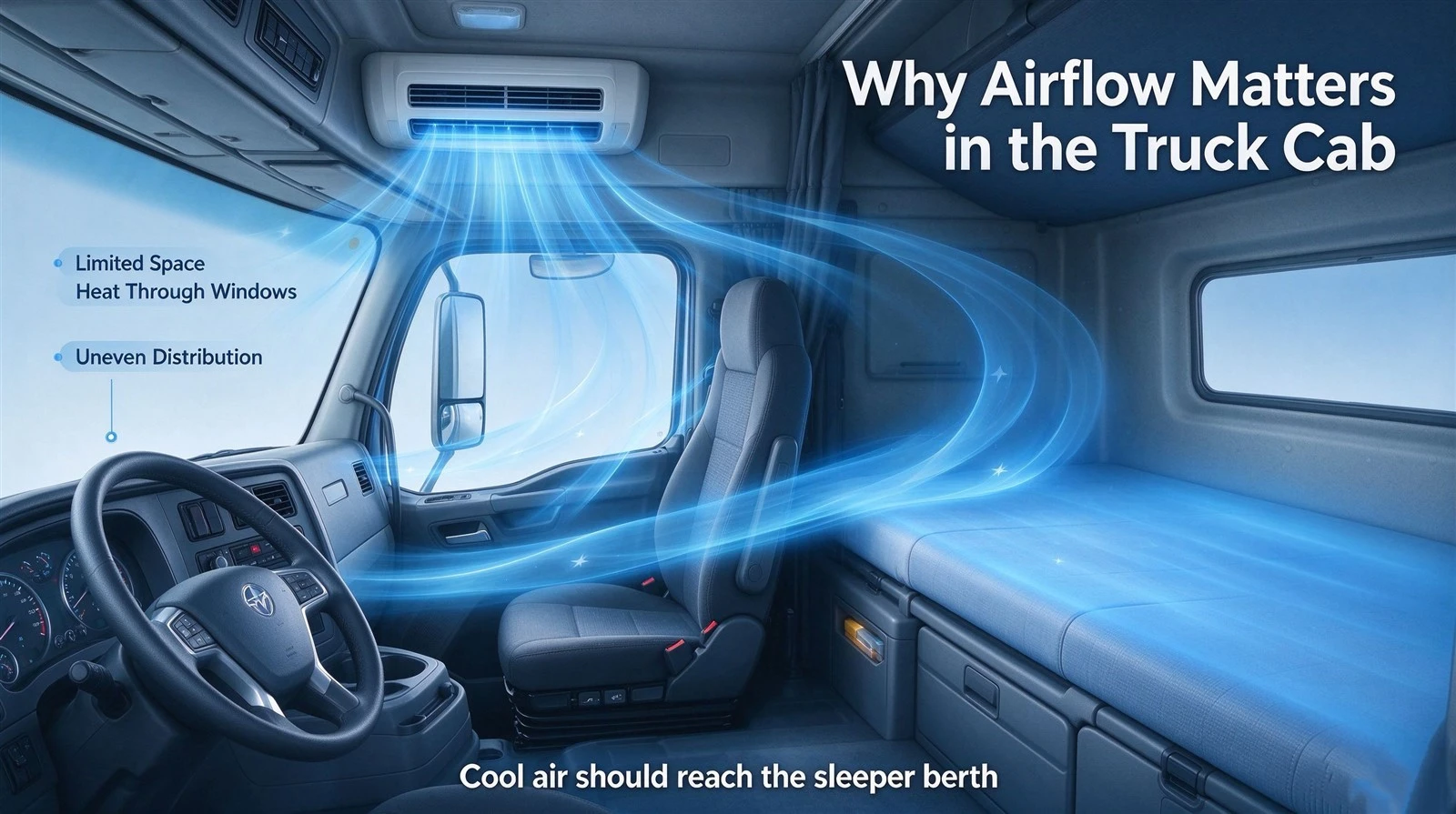
A truck cab is a relatively small space, but maintaining a comfortable temperature can be challenging.
Several factors affect how cool air moves through the interior:
Limited space:
Seats, dashboards, storage compartments, and sleeper berths can block airflow.
Heat entering through windows:
Sunlight and warm outdoor air can increase the cooling load.
Uneven air distribution:
Cool air may reach the driver's seat before reaching the rear sleeping area.
Different cooling needs:
The driver's head, upper body, and feet may experience different temperatures.
These conditions can create hot spots even when the air conditioner is running.
For long-haul drivers, the sleeper berth deserves particular attention. A unit that cools only the front section of the cab may not provide consistent comfort where the driver actually sleeps.
When comparing a truck parking air conditioner, consider whether its air outlets can direct cool air toward the sleeper berth, whether the airflow reaches the rear of the cab, and whether the system offers adjustable fan speeds.
The goal is not simply to move as much air as possible. It is to distribute cool air where it is needed.
Does Higher Airflow Mean Faster Cooling?
In many cases, adequate airflow helps an air conditioner transfer heat more effectively.
Air passes over the evaporator, where it releases heat to the refrigeration system before returning to the cab at a lower temperature. When airflow is too low, less air passes over the evaporator each hour, which can limit the system's ability to distribute cooling.
Increasing airflow within the system's designed operating range can improve heat transfer and help reduce temperature differences across the cab.
However, there is an important distinction between airflow and cooling capacity.
A larger fan does not necessarily make an air conditioner more powerful. If the evaporator, compressor, or refrigeration circuit cannot handle the additional heat load, increasing fan speed alone will not deliver the expected improvement.
For this reason, buyers should evaluate airflow together with cooling capacity and overall system performance rather than choosing a unit based on a single specification.
Airflow And Battery Consumption: Finding The Right Balance
For a battery-powered truck parking air conditioner, energy consumption is a major concern.
Drivers need enough cooling to sleep comfortably without draining the battery too quickly. Airflow plays a role in this balance, but the relationship is not as simple as choosing the lowest fan speed.
A lower fan speed generally reduces fan power consumption. However, if the airflow becomes insufficient for the cooling demand, the cab may take longer to reach a comfortable temperature.
The compressor may then need to operate for longer, depending on the system design and operating conditions.
On the other hand, running the fan at maximum speed all night may consume more energy than necessary and create unwanted air movement or noise.
A practical approach is to use a higher fan speed during the initial cooling period, then reduce the speed once the cab reaches a comfortable temperature. Automatic fan control can make this process easier when supported by the system.
Actual battery runtime depends on several factors, including:
- Air conditioner power consumption
- Battery capacity and usable energy
- Outdoor temperature and humidity
- Cab insulation and solar heat gain
- Temperature settings and fan speed
- Compressor control and operating efficiency

When selecting a battery-powered truck air conditioner, buyers should consider the complete system rather than assuming that a higher airflow rating will always reduce energy consumption.
Can Better Airflow Improve Sleeping Comfort Without Excessive Noise?
Airflow and noise are closely related, but maximum fan speed is not the only factor that matters.
At higher speeds, a fan will generally produce more noise. Poorly designed air passages, turbulence, vibration, and restrictive filters can also contribute to unwanted sound.
This creates a practical challenge for truck drivers. Strong airflow can help distribute cool air, but excessive fan noise or a direct stream of cold air toward the face may make sleeping less comfortable.
A well-designed truck parking air conditioner should balance three factors:
- Air distribution: Cool air should reach the sleeper berth and other important areas of the cab.
- Fan adjustment: Multiple fan speeds allow drivers to select a suitable airflow level for different conditions.
- Noise control: Fan design, air duct geometry, vibration management, and installation quality can all affect operating noise.
Automatic swing outlets, where available, can help distribute air across a wider area rather than directing it toward one fixed point.

When comparing products, ask for airflow and noise measurements taken under clearly stated test conditions. Maximum airflow alone does not tell you how quiet or comfortable the system will be during overnight operation.
How Much Airflow Does A Truck Parking Air Conditioner Need?
There is no single airflow rating that suits every truck.
The appropriate airflow depends on cab size, sleeper berth layout, cooling capacity, outlet position, and the design of the air distribution system.
Some products on the market advertise airflow ratings in the range of several hundred cubic meters per hour. However, these figures should not be treated as directly comparable unless the products use consistent measurement methods and operating conditions.
A unit with a higher published airflow rating may not provide better comfort if its air outlets are poorly positioned or its airflow is uneven.
Before purchasing a truck parking air conditioner, ask the supplier the following questions:
- What is the rated airflow in m³/h?
- Is the rating measured at maximum fan speed?
- What is the operating noise level at different fan speeds?
- Can the air outlets direct cool air toward the sleeper berth?
- Does the unit offer adjustable fan speeds or automatic swing airflow?
- What are the cooling capacity and typical power consumption?
- What battery capacity is recommended for the intended operating time?
These questions help buyers compare products based on practical performance rather than marketing figures alone.
What Should International Buyers Look For When Sourcing Truck Parking Air Conditioners?
For distributors, importers, and fleet equipment suppliers, choosing a truck parking air conditioner involves more than checking airflow and cooling capacity.
Product suitability, electrical compatibility, installation requirements, and technical support are also important.
When evaluating a supplier, consider the following points:
- Cooling performance: Check the rated cooling capacity and the conditions under which it was tested.
- Air distribution: Confirm that the design suits the truck cab and sleeper berth configuration.
- Power requirements: Verify operating voltage, power consumption, and compatibility with the intended battery system.
- Operating noise: Request specifications for different fan speeds where available.
- Installation: Check mounting requirements, dimensions, and compatibility with the target vehicle.
- Supplier support: Ask about technical documentation, product customization options, spare parts, and after-sales service.
These details are especially important for buyers sourcing equipment for different truck models or markets.
At Donjelion, we focus on vehicle cooling and related equipment for international markets, including truck parking air conditioning solutions. Buyers evaluating products for distribution or fleet applications can contact our team to discuss their operating requirements and identify suitable product options.
Visit our Truck Parking Air Conditioner product page to explore our range of solutions.
Frequently Asked Questions
Q: Does Higher Airflow Always Mean Better Cooling?
A: No. Higher airflow can improve air distribution and heat transfer within the system's operating range, but cooling performance also depends on cooling capacity, evaporator design, compressor performance, and the overall refrigeration system.
Q: What Is A Good Airflow Rating For A Truck Parking Air Conditioner?
A: There is no universal ideal rating. The right value depends on the truck cab, sleeper berth, cooling capacity, and air outlet design. Compare airflow specifications alongside noise levels and real-world air distribution.
Q: Does Running The Fan At A Lower Speed Save Battery Power?
A: Usually, a lower fan speed reduces fan power consumption. However, the total energy savings depend on how the entire air conditioning system responds to the lower airflow and the cooling demand.
Q: Why Is My Truck Cab Cold Near The Air Outlet But Warm At The Sleeper Berth?
A: Possible causes include insufficient airflow, obstructed air passages, poor outlet positioning, heat entering through windows, or an air conditioner that is not properly sized for the cab. Checking air distribution is a useful first step.
Q: Is Airflow Important For Overnight Truck Parking?
A: Yes. During overnight use, consistent air distribution can help reduce uncomfortable temperature differences between the driver's seat and sleeper berth. Adjustable fan speeds and suitable outlet positioning can also improve comfort.
Conclusion: Look Beyond Cooling Capacity
Choosing a truck parking air conditioner based on cooling capacity alone can overlook an important part of its performance.
Airflow affects how effectively cool air reaches the sleeper berth, how evenly the cab is cooled, and how comfortably the system operates overnight.
The best choice is not necessarily the unit with the highest airflow rating, but the one that balances cooling capacity, air distribution, noise, and energy consumption.
For truck drivers, fleet operators, and international distributors, evaluating these factors together can lead to a more suitable and reliable cooling solution.
Looking for a truck parking air conditioner for your market or fleet? Contact Donjelion to discuss your requirements and explore suitable product options.


