For years, leaving a truck engine running overnight has been a familiar solution for keeping the sleeper cab cool.
It is simple. The factory air conditioner is already there, the driver does not need additional equipment, and there is no need to think about battery capacity or installation.
But there is a problem with this approach: the truck is using a large engine simply to run an air conditioner.
For an occasional overnight stop, the extra cost may seem manageable. For a truck that spends hundreds of nights on the road every year, however, the numbers can look very different.
That is why more fleet operators and owner-operators are looking at truck parking air conditioners as an alternative to engine idling.
So which option actually costs less overnight?
The answer depends on the truck, climate, operating hours, fuel price, battery system, and AC power consumption. But when the full operating cost is considered, a dedicated parking AC can offer significant advantages.
The Real Cost Of Leaving A Truck Idling Overnight
The biggest mistake when comparing engine idling with a parking air conditioner is looking only at the price of electricity or fuel.
The engine is not running for free.
When a diesel truck idles to provide cabin cooling, fuel is being consumed even though the vehicle is not moving. The engine is also accumulating operating hours while the truck is parked.
For a driver who stops for eight or ten hours, that can add up quickly.
Consider a simple example.
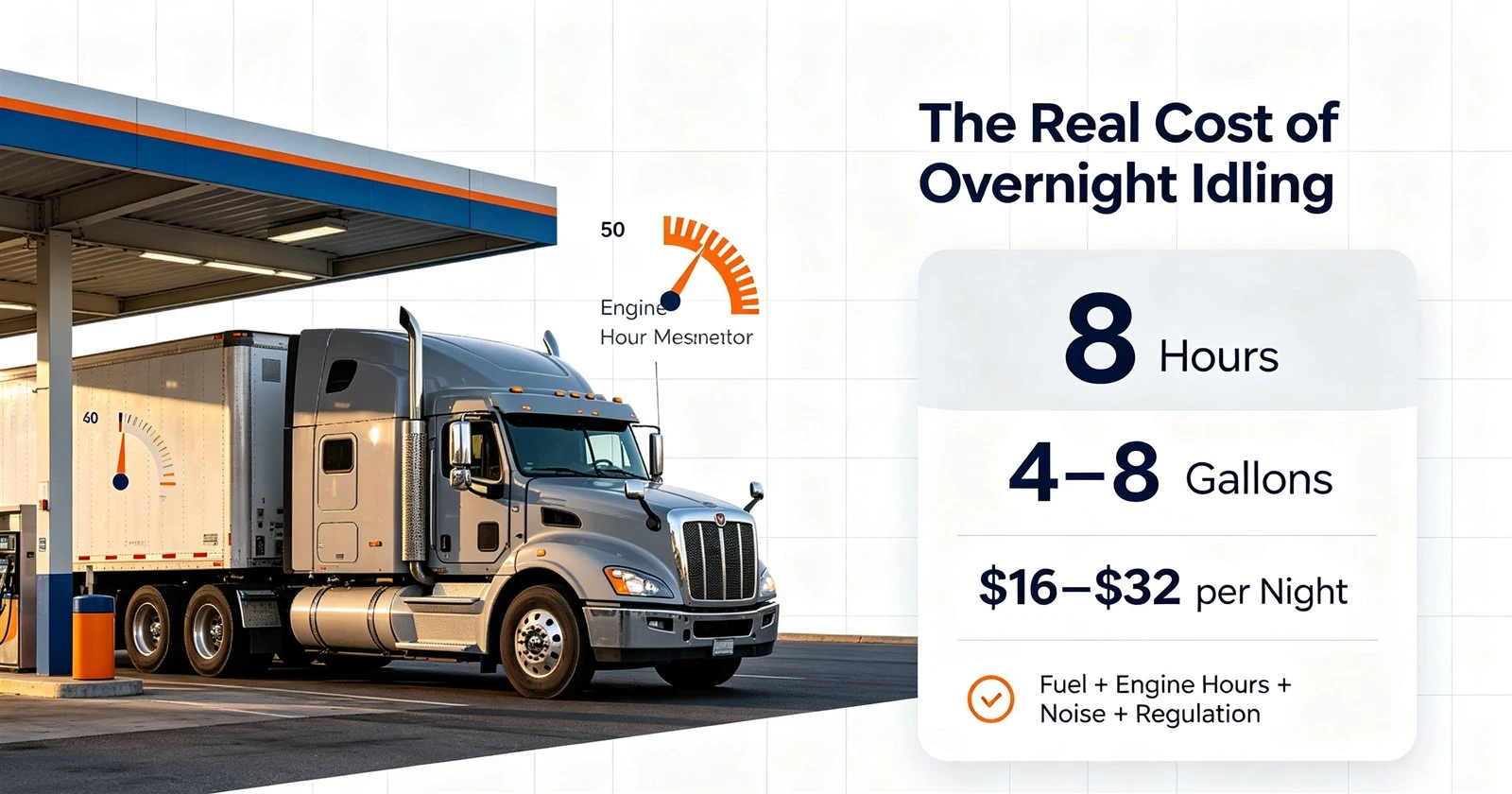
If a truck idles for 8 hours during an overnight rest and consumes approximately 0.5–1.0 gallons of diesel per hour under a particular operating condition, the overnight fuel use could be roughly:
4–8 gallons per night.
At a diesel price of $4 per gallon, that represents approximately:
$16–$32 per night.
The actual figure will vary significantly depending on the engine, idle speed, ambient conditions, truck configuration, and other loads. The purpose of the example is not to assign one universal fuel-consumption figure, but to show why overnight idling deserves attention in a fleet's operating-cost calculation.
Now multiply that by 200 nights:
$3,200–$6,400 per truck per year.
For a 50-truck fleet, the theoretical fuel expense associated with overnight idling could reach tens or hundreds of thousands of dollars over time.
That is why the question should not be:
"Can the engine keep the driver cool?"
It obviously can.
The better question is:
"Is running a large diesel engine the most economical way to cool a parked truck?"
How A Truck Parking AC Changes The Equation
A dedicated truck parking air conditioner works differently.
Instead of keeping the main engine running, the system uses electrical power to operate a dedicated compressor and cooling system.
The truck can remain parked with the engine switched off while the sleeper cab continues to receive cooled air.
This changes the cost structure.
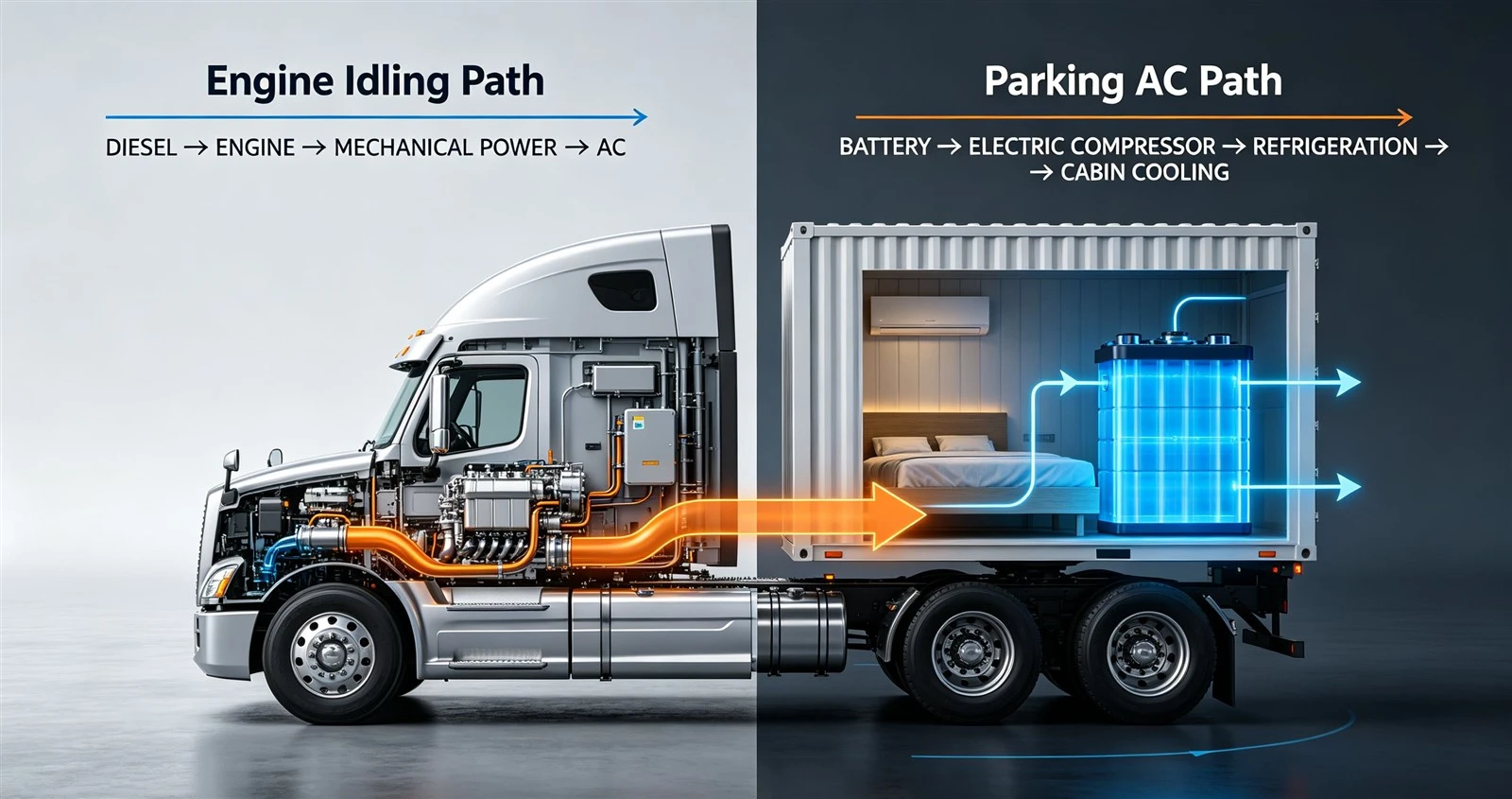
With engine idling, the primary energy source is:
Diesel fuel → Engine → Mechanical power → Air conditioning
With a battery-powered parking AC, the basic energy path becomes:
Battery → Electric compressor → Refrigeration cycle → Cabin cooling
The second approach eliminates the need to burn diesel simply to keep the sleeper cab comfortable.
However, that does not mean a parking AC is free to operate.
Electricity has a cost too, and the battery needs to be charged. The real advantage comes from comparing the energy required to provide the same amount of overnight cooling.
Why The Fuel Savings Can Be Significant
A truck engine is designed to produce enough power to move a heavy vehicle, not merely to run a small cabin cooling system while parked.
When the truck is stationary, most of that engine's capability is unnecessary.
Yet the engine still has to operate to power the vehicle's original air-conditioning system.
A dedicated parking AC separates these two functions.
The truck does not need to burn diesel merely because the driver wants air conditioning.
This can produce savings in three areas:
1. Lower Fuel Consumption
The most obvious benefit is eliminating or reducing diesel consumption associated with overnight idling.
For high-mileage fleets and trucks that spend many nights parked, this can become a meaningful operating-cost reduction.
2. Less Engine Operating Time
Even though the truck is not moving, an idling engine is still accumulating operating hours.
Reducing unnecessary idle time can help reduce the operating burden associated with:
- Engine oil
- Lubrication systems
- Belts and accessories
- Cooling systems
- Exhaust components
- Routine maintenance
The exact maintenance impact depends on the engine and maintenance schedule, so it should not be treated as a guaranteed dollar-for-dollar saving. But reducing unnecessary engine hours is generally an important fleet-management consideration.
3. Lower noise while parked
An idling diesel engine produces continuous mechanical and exhaust noise.
For drivers sleeping in truck stops, rest areas, or fleet parking areas, this can be a real comfort issue.
A dedicated electric parking AC allows the main engine to remain off, reducing the noise associated with engine operation.
But Is A Parking AC Always Cheaper?
No.
This is where a serious comparison needs to go beyond marketing claims.
A parking AC requires electrical energy.
That means the buyer needs to consider:
Battery capacity + AC power consumption + charging efficiency + operating time
A system with high power consumption may require a larger battery bank. A truck that already has limited auxiliary battery capacity may not be able to run an AC throughout the night without additional energy storage.
For example, two parking AC systems may both provide adequate cooling, but if one requires significantly more electrical power to maintain the same cabin temperature, the second system may require a larger battery investment.
Therefore, the comparison should not simply be:
Engine idling vs. parking AC
It should be:
Total overnight energy cost + equipment cost + maintenance considerations + expected service life
That is a much more useful way to evaluate the investment.
The Battery Is The Missing Piece In Many Parking AC Calculations
One of the most common purchasing mistakes is calculating parking AC runtime without looking at the battery.
A simple runtime estimate can be expressed as:
Usable battery energy ÷ average AC power consumption = approximate operating time
But real-world operation is more complicated.
Battery runtime can change depending on:
- Battery voltage
- Battery capacity
- Battery chemistry
- Depth of discharge
- Ambient temperature
- Cabin insulation
- Compressor efficiency
- AC operating mode
- Desired cabin temperature
- Other electrical loads

A 24V 400Ah battery, for example, represents a very different energy reserve from a much smaller battery bank. But even a large battery does not guarantee a specific number of operating hours because the AC's actual power consumption changes with cooling demand.
This is why parking AC and battery selection should be considered together.
Donjelion's parking air conditioning range includes 12V and 24V systems, with different configurations and compressor options intended for heavy-duty vehicle applications. The company's published product information also provides power-consumption and runtime examples based on specific battery configurations.
For fleet buyers, this approach is more useful than simply asking how many hours an AC "can" run.
The better question is:
How long will this specific AC run on the battery system installed in my truck under my normal operating conditions?
What About Extremely Hot Weather?
This is another factor that can change the economics.
A parking AC does not operate under a constant load.
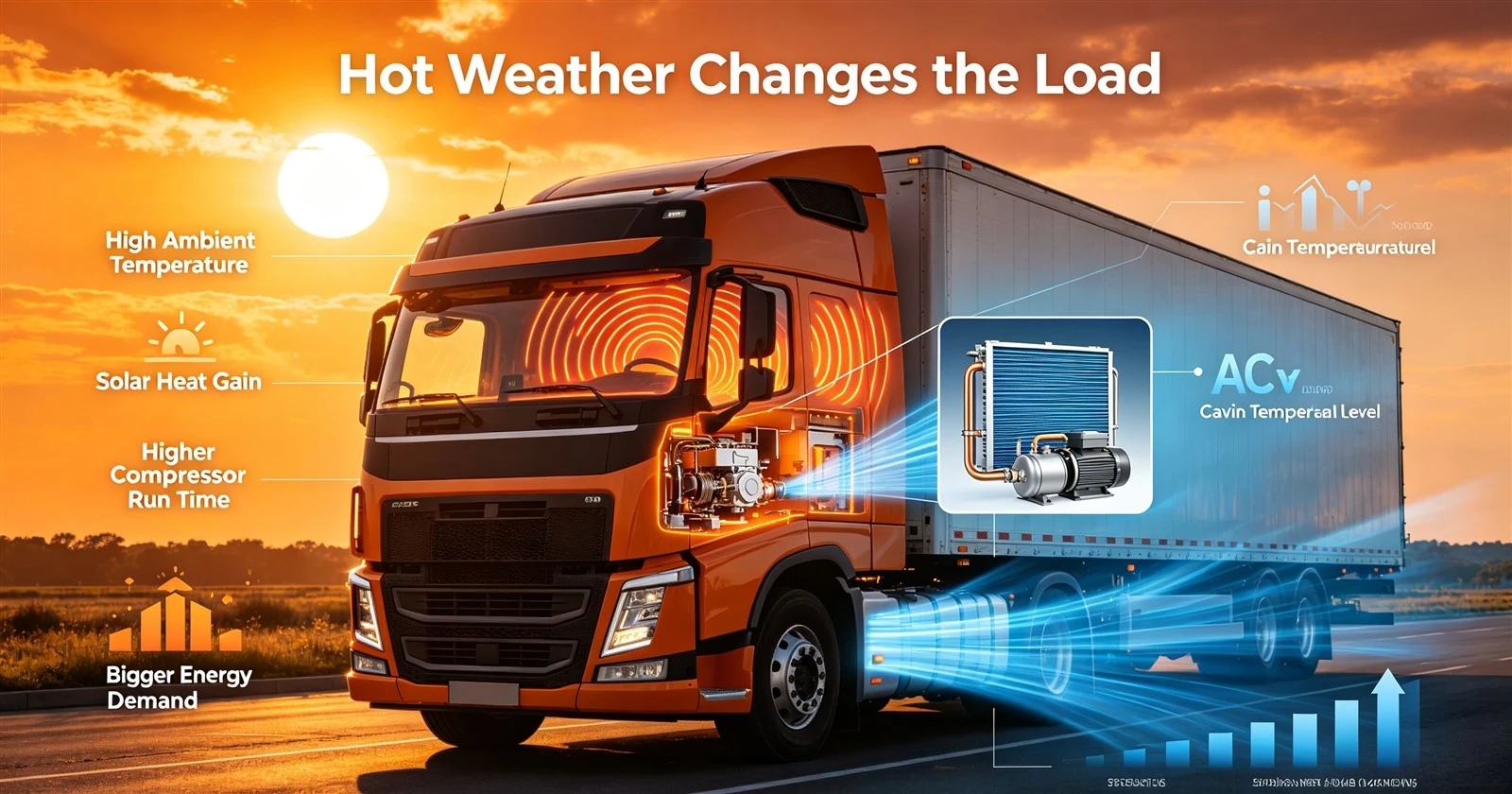
When outside temperatures rise, the cabin gains heat more quickly. Direct sunlight through the windshield and sleeper windows can also increase the cooling load.
The compressor may therefore run harder and for longer periods.
That means a parking AC that performs well in moderate conditions may consume considerably more energy during extreme summer temperatures.
Fleet buyers operating in hot regions should therefore look beyond nominal cooling capacity.
Ask the manufacturer about:
- Maximum recommended ambient temperature
- Cooling performance at high temperatures
- Compressor operating range
- Condenser design
- Protection systems
- Expected power consumption
- Recommended battery capacity
This information is much more useful than simply comparing two cooling-capacity numbers on a product sheet.
Engine Idling Has Another Cost: Regulatory Pressure
Fuel is not the only reason fleets are reducing unnecessary idling.
Across North America and other markets, anti-idling rules and emissions requirements can restrict how long heavy-duty vehicles may remain running while parked, although the exact requirements vary by jurisdiction and vehicle type.
For fleet operators, this creates an additional reason to consider independent cab climate systems.
A parking AC does not eliminate the need to understand local regulations, but it can give drivers a practical way to maintain cabin comfort without relying on continuous engine operation.
For an international manufacturer such as Donjelion, this is particularly relevant because vehicle requirements differ between export markets. A parking AC solution needs to be evaluated according to the vehicle platform, climate, electrical system, and local operating environment rather than treated as a one-size-fits-all product.
A Simple Overnight Cost Comparison
Let's use a simplified example to understand the difference.
Assume a truck needs cooling for 8 hours overnight.
Option A: Engine Idling
Assume:
8 hours of idling
0.5–1.0 gallons of diesel per hour
$4 per gallon
Estimated fuel cost:
$16–$32 per night
Again, actual fuel consumption can vary considerably.
Option B: Battery-Powered Parking AC
Suppose a parking AC averages 1.0–1.5 kW of electrical consumption under a particular operating condition.
Over 8 hours:
8–12 kWh of energy
The actual energy required will depend on compressor cycling, temperature settings, cabin insulation, and environmental conditions.
If that energy comes from a rechargeable battery system, the cost of electricity used to recharge the battery may be substantially different from the direct cost of burning diesel during eight hours of engine idling.
But there is an important caveat:
The purchase price of the AC and battery system must also be considered.
This is why the correct economic metric is not simply "fuel saved tonight."
It is:
Total Cost of Ownership
A fleet should consider:
Equipment cost + installation + energy + maintenance + replacement parts − operating savings
Over several years, that calculation provides a much clearer picture of whether the investment makes sense.
When Does A Parking AC Make The Most Financial Sense?
A dedicated truck parking air conditioner becomes particularly attractive when the vehicle:
- Frequently stops overnight
- Operates in hot climates
- Spends long periods at truck stops
- Has high annual idle hours
- Is subject to anti-idling restrictions
- Requires quiet overnight operation
- Has sufficient battery capacity or can accommodate an auxiliary battery system
For a truck that rarely parks overnight, the financial payback may be less compelling.
For a long-haul truck that spends hundreds of nights away from home, however, reducing unnecessary engine idling can become a meaningful part of the operating-cost strategy.
What Should Fleet Buyers Compare Before Choosing A Parking AC?
If you are comparing suppliers, do not ask only for the unit price.
Ask each manufacturer to provide comparable information for:
Cooling
Rated cooling capacity
Cooling performance under high ambient temperatures
Airflow
Recommended sleeper-cab size
Electrical
Rated voltage
Rated current
Typical power consumption
Maximum power consumption
Recommended battery capacity
Operation
Expected runtime
Compressor operating mode
Low-voltage protection
High-temperature protection
Automatic restart or control functions
Installation
Roof or split installation
Required mounting dimensions
Vehicle compatibility
Wiring requirements
Installation instructions
Long-Term Support
Warranty
Spare parts
Technical support
Replacement components
OEM/ODM capability
Lead time
Comparing these specifications side by side will usually tell you much more than comparing three supplier quotations.
Why Donjelion Focuses On The Complete Parking AC Solution
For overseas buyers, the manufacturer behind the product matters.
A truck parking AC may need to operate for many hours in demanding conditions, sometimes in extreme heat and sometimes with limited battery capacity. Reliability therefore depends on more than the appearance of the finished unit.
Donjelion focuses primarily on truck parking air conditioning systems, while also developing related vehicle products including diesel heaters, car refrigerators, and lithium battery solutions.
Its parking AC range covers 12V and 24V applications and multiple installation configurations for different heavy-duty vehicle requirements. The company also works with customers on customized configurations rather than limiting every application to a single standard specification.
This broader product capability is useful when a customer is evaluating the entire overnight-comfort system rather than purchasing an air conditioner in isolation.
For example, a fleet may need to consider:
Parking AC → Battery → Charging → Cabin heating → Refrigeration
instead of looking at each product separately.
That system-level approach can be especially important for international distributors and fleet customers whose vehicles, climates, and operating conditions vary from one market to another.
So, Which Costs Less: Idling Or Parking AC?
For occasional use, engine idling may appear to be the simplest option.
But for trucks that regularly spend long periods parked, the economics become harder to ignore.
Engine idling consumes diesel, adds operating hours, produces noise, and may create additional regulatory challenges.
A dedicated truck parking AC requires an upfront investment and depends on an appropriate battery system, but it can separate cabin cooling from engine operation and reduce the need to burn fuel simply to keep a driver comfortable.

The most important point is this:
Don't compare a parking AC with engine idling by purchase price alone. Compare the total cost of keeping the truck comfortable overnight.
For fleet operators, that means looking at fuel, electricity, battery capacity, maintenance, regulations, driver comfort, and equipment life together.
And for buyers evaluating a new parking AC, the right question isn't simply:
"Which unit is cheapest?"
It is:
"Which system can provide reliable overnight cooling at the lowest total operating cost for my trucks?"
That is the comparison that matters.