

One of the first questions buyers ask before investing in a truck parking air conditioner is simple:
How long will it actually run on a battery?
The honest answer is: it depends.
A parking AC may run for only a few hours on an undersized battery system-or comfortably through an entire overnight rest period when the air conditioner, battery capacity, voltage, and operating conditions are properly matched.
That difference is important for truck owners, fleet managers, distributors, and overseas buyers. A parking air conditioner is not just a cooling product. It is part of a larger energy system.
The AC consumes power. The battery stores energy. The truck's charging system restores that energy. Cabin temperature, weather, insulation, and driver settings determine how quickly the stored energy is used.
So instead of asking only, "How many hours can this AC run?", buyers should ask a more useful question:
"How long can this specific parking AC run on my truck's battery system under real operating conditions?"
This guide explains how truck parking AC runtime is calculated, what affects overnight performance, and how buyers can avoid the most common battery-sizing mistakes.
The Short Answer: Most Systems Need More Than A Simple Ah Number
Many buyers start by looking at battery capacity:
150Ah,200Ah,300Ah,400Ah
But amp-hours alone do not tell you how much energy is available.
For example:
- A 12V 200Ah battery stores approximately 2.4kWh of theoretical energy.
- A 24V 200Ah battery stores approximately 4.8kWh of theoretical energy.
The Ah rating is identical, but the total stored energy is very different.
That is why parking AC runtime should be discussed in terms of:
- Battery voltage
- Battery capacity
- Usable battery energy
- Average AC power consumption
- Operating conditions
The basic calculation is straightforward:
Approximate Runtime = Usable Battery Energy ÷ Average AC Power Consumption
The challenge is determining the two numbers accurately.
Step 1: Calculate The Battery's Available Energy
Battery energy is usually expressed in watt-hours (Wh) or kilowatt-hours (kWh).
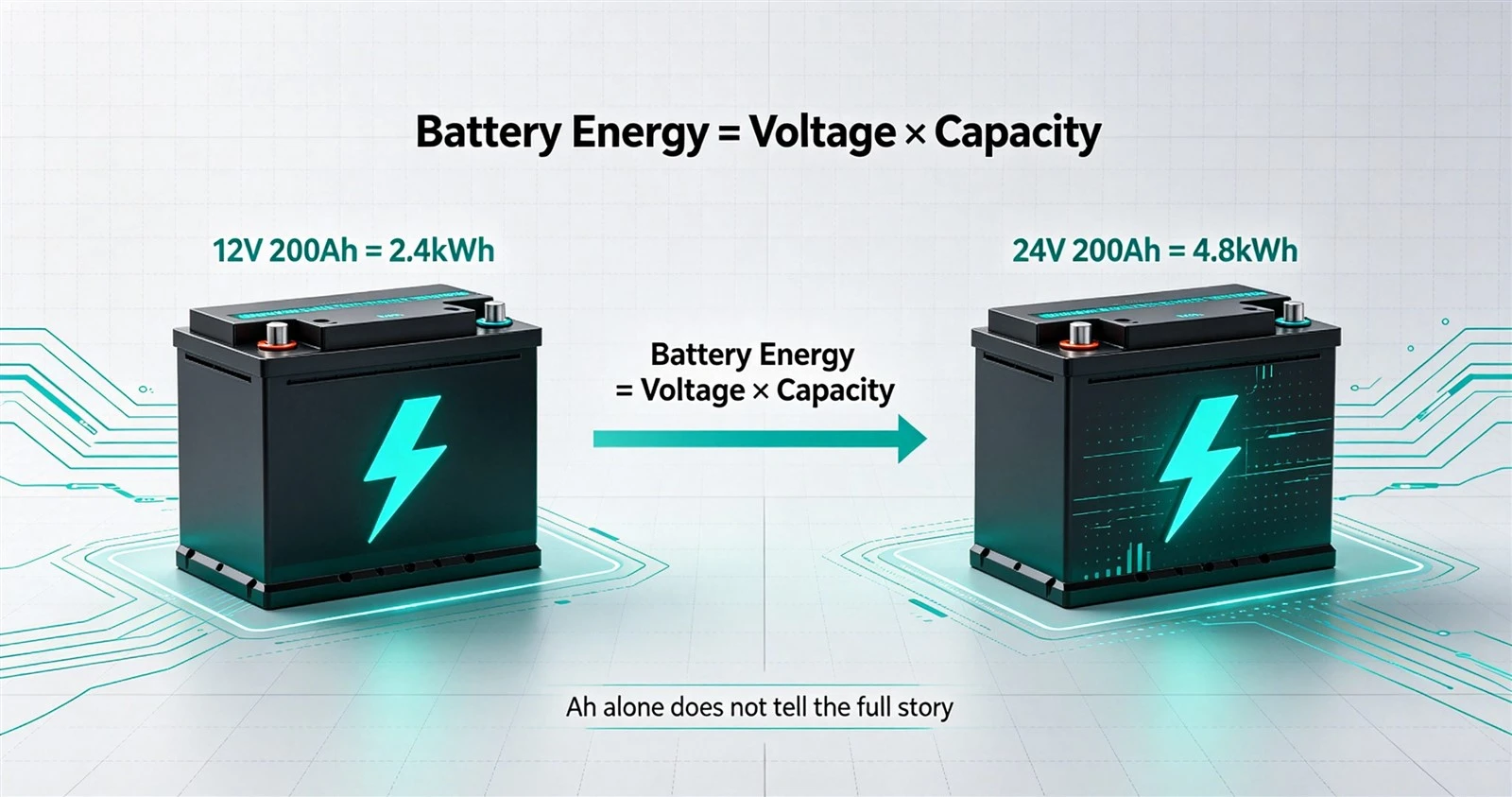
A simple calculation is:
Battery Energy (Wh) = Voltage (V) × Capacity (Ah)
For example:
Example 1: 12V 200Ah Battery
12V × 200Ah = 2,400Wh
Or:
2.4kWh
Example 2: 24V 200Ah Battery
24V × 200Ah = 4,800Wh
Or:
4.8kWh
Example 3: 24V 400Ah Battery
24V × 400Ah = 9,600Wh
Or:
9.6kWh
At first glance, a 9.6kWh battery system may sound sufficient for almost any overnight parking AC application.
But there is another important factor.
Not all of the battery's theoretical capacity should be treated as usable operating energy.
Step 2: Understand Usable Battery Capacity
A battery is not an unlimited energy tank.
In a real truck application, some energy may need to remain available for:
- Engine starting
- Battery protection
- Voltage stability
- Other electrical loads
- Unexpected longer parking periods
The usable portion of the battery also depends on battery chemistry and system design.
For example, different battery technologies may have different practical depth-of-discharge characteristics. A lithium battery system designed for deep cycling may provide a larger usable portion of its stored energy than a traditional starter battery, but the actual result depends on the battery's BMS, protection settings, charging system, and manufacturer recommendations.
For this reason, buyers should avoid a calculation like this:
"My AC needs 8kWh, so I will buy an 8kWh battery."
That leaves no practical margin.
A better approach is to include a reserve for:
- Hot weather
- Battery aging
- Other electrical equipment
- Energy losses
- Longer-than-planned parking periods
The goal is not to make the battery calculation look perfect on paper.
The goal is to make sure the driver is still comfortable at 3:00 a.m.
Step 3: Check The AC's Actual Power Consumption

This is where many buyers make the biggest mistake.
They confuse cooling capacity with electrical power consumption.
These are not the same thing.
A truck parking air conditioner may have a cooling capacity of 2,000W or 2,500W, but that does not mean it consumes 2,000W or 2,500W of electrical power continuously.
Cooling capacity describes how much heat the system can remove.
Power consumption describes how much electrical energy the system uses.
For battery runtime, power consumption is the critical number.
Depending on the product, operating mode, compressor technology, and cooling demand, power consumption may change significantly throughout the night.
Donjelion's published parking AC information, for example, shows different consumption levels depending on compressor type and operating mode. Its product information lists lower power consumption in sleep mode and higher consumption in stronger cooling modes. (青岛东杰国际贸易有限公司)
This is why a buyer should not ask only:
"What is the rated cooling capacity?"
They should also ask:
- What is the maximum power consumption?
- What is the typical operating power?
- What is the consumption in sleep mode?
- Does the compressor adjust its output?
- What happens after the cab reaches the set temperature?
Those answers are much more useful when estimating overnight runtime.
A Simple Truck Parking AC Runtime Example
Let's assume:
• Battery system: 24V 400Ah
• Theoretical battery energy: 9.6kWh
• Average AC consumption: 800W
Theoretical calculation:
9,600Wh ÷ 800W = 12 hours
That does not mean the truck will always receive exactly 12 hours of cooling.

The actual runtime may change depending on:
- Usable battery capacity
- Battery age
- Outside temperature
- Cab insulation
- Thermostat setting
- Compressor operating mode
- Other electrical loads
But the calculation provides a useful starting point.
Now compare the same battery with a system averaging 1,200W:
9,600Wh ÷ 1,200W = 8 hours
A difference of only 400W in average power consumption can reduce theoretical runtime by approximately four hours.
This is why energy efficiency matters so much in parking AC selection.
Why Two Similar Parking ACs Can Have Very Different Runtime

Two products may have similar cooling performance but produce very different battery results.
The difference can come from:
1. Compressor Technology
The compressor is one of the most important components affecting power consumption.
A system that can adjust its output according to cooling demand may avoid operating at maximum power continuously after the cabin reaches the desired temperature.
This can help reduce average overnight energy consumption.
Donjelion's product range includes parking AC systems using different compressor configurations, with published operating modes that show different power-consumption levels.
For buyers, the important question is not simply:
"What compressor does the AC use?"
It is:
"How efficiently does the complete system manage power during real overnight operation?"
2. Outdoor Temperature
A parking AC does not consume the same amount of power every night.
A truck parked at 25°C is facing a very different cooling load from one parked at 40°C.
High ambient temperatures can cause:
- Longer compressor operation
- Higher electrical consumption
- Slower cabin temperature reduction
- Shorter battery runtime
The first few hours after parking can also be the most demanding.
If the cab has been sitting in direct sunlight all afternoon, the AC must remove stored heat from:
- The roof
- Dashboard
- Seats
- Interior panels
- Sleeper area
That initial cooling period can consume considerably more energy than maintaining a comfortable temperature later in the night.
3. Thermostat Setting
Lower is not always better.
Setting the cabin temperature extremely low increases the cooling demand.
For example, maintaining a cabin at a moderate sleeping temperature usually requires less energy than attempting to create an extremely cold environment while outside temperatures remain high.
A practical strategy is:
- Cool the cab quickly after parking.
- Allow the temperature to stabilize.
- Use a reasonable overnight temperature setting.
This approach can reduce unnecessary compressor operation and extend battery runtime.
4. Truck Cab Insulation
The AC is not the only factor controlling runtime.
The truck itself matters.
A well-insulated sleeper cab can retain cooled air longer.
A poorly insulated cab allows heat to enter more quickly.
This means two identical trucks with the same AC and battery could have different overnight runtime simply because of:
- Window area
- Roof insulation
- Door seals
- Sleeper-cab design
- Solar exposure
This is why manufacturers should be careful about promising one fixed runtime number for every truck.
5. Other Electrical Equipment
The parking AC may not be the only device running overnight.
A long-haul driver may also use:
- A truck refrigerator
- Interior lights
- Phone charging
- Entertainment equipment
- Fans
- Auxiliary electronics
Individually, these loads may seem small.
Together, they can reduce the energy available to the AC.
A complete overnight energy calculation should therefore include:
Parking AC + Refrigerator + Electronics + Lighting + Other Loads
This is particularly relevant for fleet buyers and distributors who are developing complete off-engine comfort packages rather than selling individual products separately.
How Long Can A Donjelion Parking AC Run?
The runtime depends on the specific model, compressor configuration, operating mode, and battery system.
According to Donjelion's published parking AC information:
- Scroll compressor systems are listed at approximately 600W in sleep mode and 800–1000W in strong mode.
- Rotor compressor systems are listed at approximately 400W in sleep mode and 700–800W in strong mode.
- Using a 24V 400Ah battery as a reference configuration, the published examples indicate approximately 10–12 hours for certain scroll-compressor configurations and 14–16 hours for certain rotor-compressor configurations.
These figures should be treated as application examples rather than a universal guarantee.
Real-world runtime will depend on the vehicle, weather, battery condition, and operating settings.
That distinction is important.
A serious supplier should help the buyer understand the conditions behind a runtime estimate-not simply advertise the longest possible number.
12V Vs. 24V: Does Voltage Affect Runtime?
Yes, but the comparison must be made correctly.
Consider two batteries:
12V 200Ah
Energy:
12 × 200 = 2.4kWh
24V 200Ah
Energy:
24 × 200 = 4.8kWh
The 24V battery stores approximately twice the theoretical energy because the voltage is twice as high.
This is why comparing battery systems only by Ah can be misleading.
For heavy-duty truck applications, the vehicle's electrical platform must always be considered when selecting a parking AC.
Donjelion offers parking AC solutions for both 12V and 24V applications, allowing overseas buyers to select systems according to the vehicle platform and intended use.
The correct choice should be based on:
- Truck electrical architecture
- Required cooling capacity
- Battery configuration
- Installation requirements
- Expected operating time
Not simply on which system has the largest Ah number.
How Much Battery Do You Need For An Overnight Parking AC?
There is no universal answer.
However, buyers can use this process.
Scenario A: Moderate Overnight Use
Suppose:
Average AC consumption: 600W
Required runtime: 8 hours
Energy requirement:
600W × 8 hours = 4.8kWh
The battery system must provide at least that amount of usable energy, plus an appropriate safety margin.
Scenario B: Hot Climate
Suppose:
- Average AC consumption: 1,000W
- Required runtime: 8 hours
Energy requirement:
1,000W × 8 hours = 8kWh
The battery requirement is now significantly larger.
Scenario C: AC Plus Other Loads
Suppose:
Parking AC average: 800W
Refrigerator average: 60W
Other loads: 100W
Total average demand: 960W
Required runtime: 8 hours
Energy requirement:
960W × 8 hours = 7.68kWh
This example demonstrates why a complete energy calculation is more accurate than sizing the battery around the AC alone.
Five Reasons A Parking AC May Shut Down Earlier Than Expected
If a truck parking AC does not last through the night, the AC itself may not be the only problem.
Here are five common causes.
1. The Battery Is Too Small
The most obvious issue is insufficient usable energy.
The battery may have enough capacity for a few hours but not enough for an entire overnight rest period.
01
2. The Battery Is Aging
Battery capacity decreases over time.
A battery that originally supported overnight cooling may gradually provide less runtime as it ages.
02
3. The Low-Voltage Protection Activates
Most parking AC systems include low-voltage protection to prevent excessive battery discharge.
When the system detects that voltage has fallen below the protection threshold, it may shut down.
This can protect the battery and help prevent the truck from being left with insufficient starting power.
03
4. The Weather Is Extremely Hot
High temperatures increase the cooling load.
The compressor may remain active for longer periods, increasing power consumption.
04
5. The System Was Never Sized Correctly
This is the underlying problem in many cases.
The buyer selected:
- The AC separately
- The battery separately
- The installation separately
No one evaluated the complete system.
A better approach is to design the overnight energy system as one package.
05
Parking AC And Battery Should Be Selected Together
For a long-haul truck, overnight comfort may depend on several connected products:
Parking AC → Battery → Charging System → Refrigerator → Auxiliary Loads

Changing one component can affect the others.
For example:
- A more powerful AC may require more battery capacity.
- A larger battery may require a different charging strategy.
- Adding a refrigerator increases overnight energy demand.
- A diesel heater may reduce the need for electric heating during cold conditions.
This is why system-level planning is becoming increasingly important for fleets and international buyers.
Donjelion's product portfolio covers several connected vehicle comfort and energy categories, including:
- Truck parking air conditioners
- Diesel air heaters
- Vehicle refrigerators
- Lithium battery products
- Heavy-duty auxiliary power solutions
This allows buyers to evaluate different parts of the overnight truck environment together instead of treating every product as an isolated purchase.
What Fleet Buyers Should Ask Before Ordering
Before purchasing a large number of parking AC systems, fleet managers should collect the following information.
About the Truck
- Is the electrical system 12V or 24V?
- What is the existing battery capacity?
- How old are the batteries?
- What charging system is installed?
- How much installation space is available?
About the Driver's Operating Pattern
- How many hours does the truck normally park overnight?
- How often is overnight cooling required?
- What are the typical summer temperatures?
- Does the truck frequently park in direct sunlight?
About the AC
- What is the typical-not just maximum-power consumption?
- Does the system have a sleep or economy mode?
- How does the compressor respond to changing cooling demand?
- What low-voltage protection is included?
About the Battery
- How much usable energy is available?
- Is the battery designed for repeated deep cycling?
- What reserve capacity is required?
- How long will charging take?
When these questions are answered before the purchase, buyers are much less likely to experience disappointing runtime after installation.
How Donjelion Supports Overseas Truck Parking AC Buyers
For international markets, one standard configuration is rarely suitable for every customer.
Truck voltage, cab size, climate, parking habits, and battery systems can vary significantly from country to country.
Donjelion focuses primarily on truck parking air conditioning solutions and supplies products for overseas markets. Its parking AC range includes 12V and 24V configurations, while its wider product portfolio also includes diesel heaters, vehicle refrigerators, lithium battery products, and heavy-duty auxiliary power solutions.
For buyers, the advantage of working from a broader system perspective is simple:
Instead of asking only:
"Which AC should I buy?"
You can evaluate:
Which AC and energy configuration is most suitable for this truck and this market?
That is a more useful starting point for fleets, distributors, importers, and OEM customers.
Final Answer: How Long Will A Truck Parking AC Run On A Battery?
A properly matched truck parking AC system can often provide overnight cooling, but the actual runtime depends on the complete energy system.
The most important variables are:
- Battery voltage
- Battery capacity
- Usable battery energy
- Average AC power consumption
- Outside temperature
- Cab insulation
- Thermostat setting
- Other electrical loads
- Battery condition
- Required operating time
The most reliable calculation starts with energy-not just amp-hours.
Usable Battery Energy ÷ Average Power Consumption = Approximate Runtime
Then add a realistic safety margin.
For truck owners, the goal is simple: stay comfortable through the night without waking up to a discharged battery.
For fleet managers, the goal is broader: reduce unnecessary engine idling while maintaining reliable driver comfort and predictable operating costs.
And for overseas buyers, the best parking AC is not necessarily the one with the highest cooling number or the lowest price.
It is the one that matches the truck, battery, climate, and real-world operating conditions.
That is why battery sizing should never be an afterthought when buying a truck parking air conditioner. It should be part of the original system design.


