

A car refrigerator can make a big difference on long road trips, camping weekends, delivery routes, and daily driving. It allows drivers and passengers to keep drinks cold, store fresh food, and, depending on the model, even freeze items without relying on a traditional household refrigerator.
However, not every car refrigerator is designed for the same purpose. Cooling technology, sealing performance, capacity, functions, and overall product quality can vary considerably between models.
For buyers comparing different options, focusing on appearance or price alone can lead to the wrong choice. Before purchasing a car refrigerator, it is worth checking the following five factors.
1. Check The Cooling Performance
Cooling performance should be one of the first things to consider when choosing a car refrigerator.
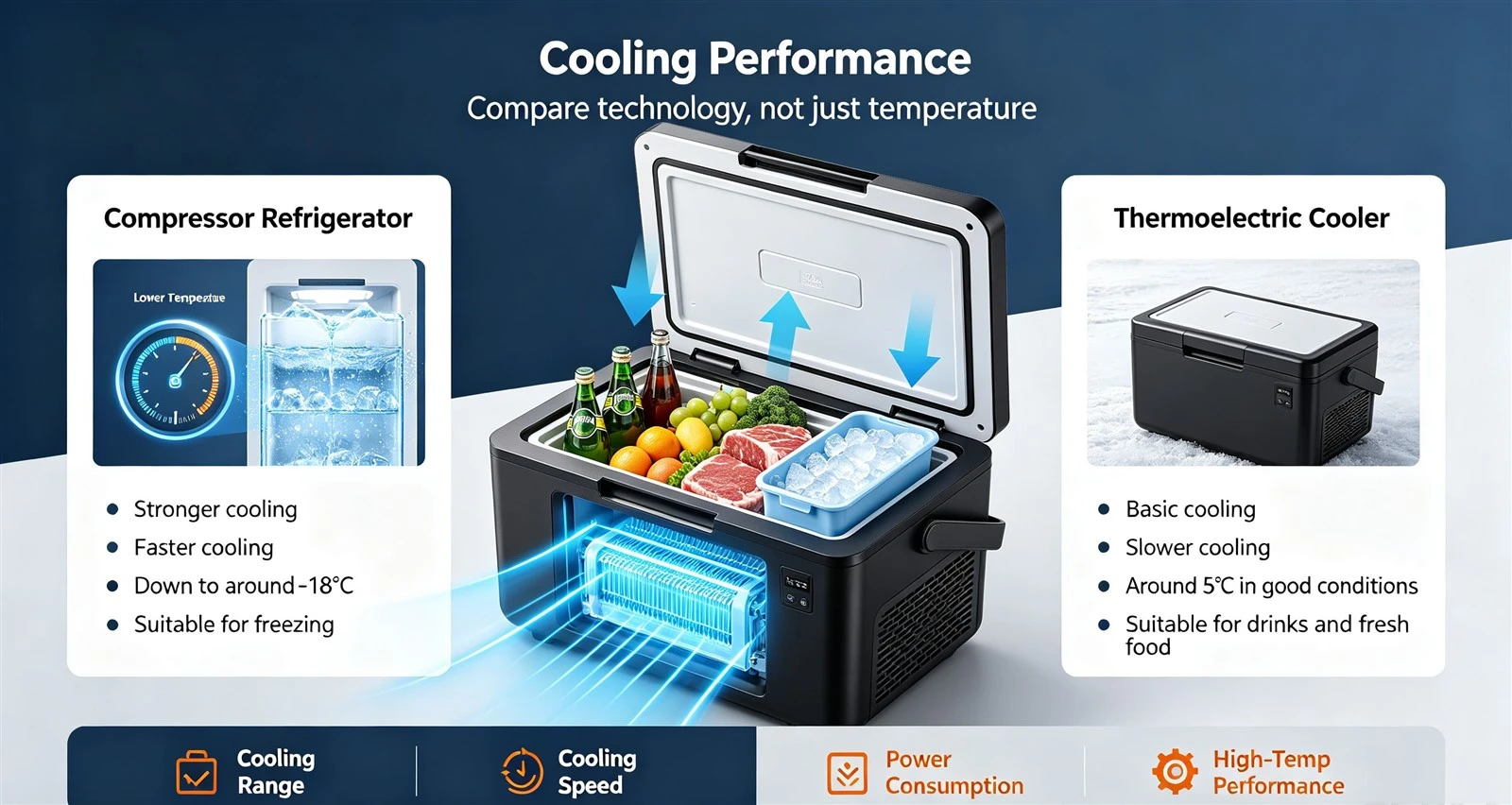
Different refrigeration technologies provide very different results. Semiconductor or thermoelectric models are generally designed for basic cooling and are suitable when users mainly need to keep drinks and food cool. Under suitable conditions, some models can cool to around 5°C, although cooling speed depends on the starting temperature, ambient temperature, power supply, and other factors.
Compressor car refrigerators are designed for stronger and faster refrigeration. Many compressor models can reach temperatures around -18°C, making them suitable not only for cooling beverages and fresh food but also for temporary freezing. A quality compressor unit may cool from approximately 20°C to 0°C much faster than a thermoelectric model under comparable conditions.
This difference becomes particularly important for truck drivers, campers, and travelers who need reliable cooling during extended journeys.
When comparing products, don't look only at the lowest advertised temperature. Check the cooling range, cooling speed, compressor type, power consumption, and performance under high ambient temperatures.
2. Pay Attention To The Door Sealing Strip
The sealing strip around the refrigerator door may look like a small detail, but it plays an important role in maintaining stable internal temperatures.
A well-designed sealing strip helps reduce the exchange of warm outside air with cold air inside the refrigerator. This allows the cooling system to maintain the target temperature more efficiently and can help reduce unnecessary energy consumption.
When inspecting a car refrigerator, check whether the door seal feels flexible, durable, and evenly fitted around the entire opening. A good-quality seal should have sufficient elasticity and provide consistent contact when the door is closed.
Buyers should also check the overall construction of the door and cabinet. A refrigerator with a powerful cooling system can still lose efficiency if the door does not close properly or the seal is poorly designed.

For a vehicle refrigerator that may experience vibration and frequent opening and closing, sealing quality and construction durability are especially important.
3. Choose The Right Capacity
A larger refrigerator is not automatically a better refrigerator.
The right capacity depends on how and where the unit will be used. A compact refrigerator may be more practical for a passenger car, while truck drivers, RV owners, and families traveling for several days may need a larger storage compartment.
Small-capacity models are often convenient for installation between the front seats. They can provide easy access to drinks and snacks while driving or during rest stops.
Larger models are generally better suited to the trunk, cargo area, RV, or truck sleeper compartment. They provide more storage space but also require more installation room.
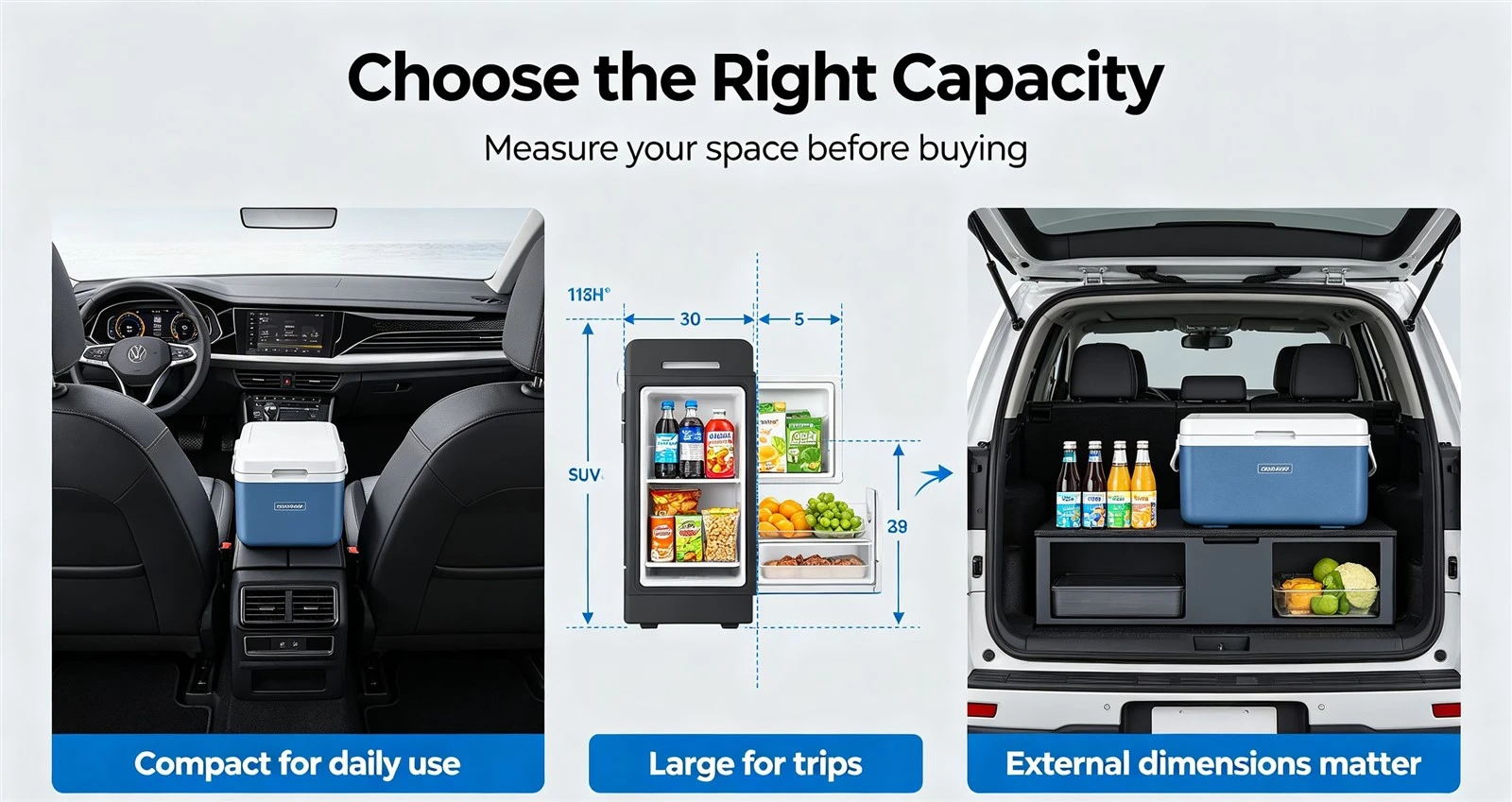
The door design should also be considered before purchasing. If the refrigerator will be installed between the front seats, a top-opening or flip-up door design can be more practical than a traditional side-opening door. Otherwise, limited space may make it difficult to fully open the door after installation.
Before ordering, measure the available installation space and compare it with the refrigerator's external dimensions-not just its advertised internal capacity.
4. Check The Functions You Actually Need
Car refrigerators can also be divided according to their functions.
For buyers who mainly need refrigeration and freezing during summer or long-distance travel, a single-cooling compressor refrigerator can be an efficient choice. These models are designed specifically for refrigeration and generally provide stronger cooling performance than basic thermoelectric units.
Some vehicle refrigerators also offer both cooling and heating functions. This type of product can be used to keep food and beverages cold in summer and warm certain items during colder seasons.

However, multifunctional products may involve different performance characteristics and trade-offs compared with a dedicated compressor refrigerator. If your primary requirement is fast cooling and low-temperature freezing, a dedicated compressor model may be more suitable.
Instead of paying for functions you rarely use, consider your actual driving environment and daily requirements.
Ask yourself:
- Do I need freezing capability?
- Will the refrigerator run for many hours at a time?
- Is low power consumption important?
- Do I need both cooling and heating?
- Will it be installed in a car, truck, RV, or another vehicle?
The answers can help narrow down the right product much faster.
5. Consider The Manufacturer And Product Quality

Price is important, but it should not be the only factor when comparing car refrigerators.
A vehicle refrigerator may be exposed to vibration, temperature changes, frequent transportation, and continuous operation. Product quality therefore has a direct impact on reliability and service life.
When comparing manufacturers, look beyond the product photos and advertised specifications. Consider the company's manufacturing experience, quality-control process, technical support, warranty policy, and after-sales service.
Established manufacturers are often able to provide more consistent production quality and better technical support. Buyers purchasing refrigerators for commercial vehicles or fleet applications should pay particular attention to these factors because equipment downtime can be more costly than the initial purchase price.
For international buyers, communication, spare-parts availability, product documentation, and export experience can also make a significant difference.
Don't Choose A Car Refrigerator Based On Price Alone
Choosing a car refrigerator is essentially a balance between cooling performance, size, power consumption, functions, durability, and price.
A low-cost refrigerator may appear attractive initially, but it may not provide the cooling capacity or long-term reliability required for extended use. On the other hand, buying the largest or most expensive model does not necessarily mean getting the best solution.
The better approach is to start with your actual application. A driver who needs cold drinks during daily commuting has very different requirements from a long-haul truck driver who needs overnight refrigeration or freezing.
For buyers looking for vehicle refrigeration solutions, DONJELION focuses on products designed around practical vehicle-use requirements, with attention to cooling performance, energy efficiency, installation convenience, and long-term operation.
Final Thoughts
The best car refrigerator is not necessarily the one with the most features or the lowest price. It is the one that matches your vehicle, available installation space, expected operating time, storage needs, and required temperature range.
Before making a purchase, compare the cooling technology, temperature range, sealing strip, capacity, door design, functions, power consumption, and manufacturer support. Taking a few extra minutes to evaluate these details can help prevent an unsuitable purchase and provide a more reliable refrigeration solution for the road.
Whether you are preparing for a long-distance truck route, a family road trip, an RV adventure, or everyday vehicle use, choosing the right car refrigerator can make traveling with fresh food and cold drinks much easier.


